Category: 2025

  • The Corporate Alchemist: Who is the Digital Transformation Manager?

    The Corporate Alchemist: Who is the Digital Transformation Manager?

    Companies pour billions into new software, cloud infrastructure, and AI initiatives, all in the name of “digital transformation.” Yet, so many of these ambitious projects stall, crashing against the unyielding walls of company culture, departmental silos, and human inertia. The reason is simple: we’ve often focused on the “digital” and forgotten the “transformation.”

    Enter the Digital Transformation Manager. This isn’t just a new title for an IT director; it’s a different role entirely. Think of them less as a manager and more as a corporate alchemist—someone tasked with turning the lead of old processes and legacy thinking into the gold of a truly modern, agile organization. They are the essential human bridge between the technology of tomorrow and the business of today.

    At their core, these leaders are diplomats and translators. They must be fluent in the conflicting languages of the boardroom, the engineering team, and the front lines. They articulate a vision to the C-suite in the language of ROI and market share, then turn around and discuss APIs and data architecture with developers. Crucially, they connect with frontline employees, understanding their workflows and addressing the fear that inevitably accompanies change. They ensure the boardroom’s ‘why’ connects with the engineer’s ‘how’ and the employee’s ‘what’s in it for me?’

    Beyond translation, they are the architects of a new reality. A common mistake is seeing this role as simply implementing new tools. That’s like saying an architect’s job is just to lay bricks. Instead, they design the blueprint for a new way of working. They are obsessed with demolishing silos, asking why sales and marketing data are disconnected or why product development and customer support operate in different worlds. They re-engineer the organizational structure to create flow, collaboration, and speed where there was once friction and delay.

    Perhaps their most critical function is acting as a catalyst for cultural change. Technology is the easy part; changing mindsets is the real challenge. The Digital Transformation Manager champions psychological safety, creating an environment where employees feel safe to experiment and fail. They foster a data-driven mindset, shifting decisions away from gut feelings toward objective metrics. They are the organization’s coach and cheerleader, constantly reinforcing the vision and celebrating small wins to build momentum.

    This role is not for the faint of heart. It requires a rare blend of strategic vision, technical savvy, and profound emotional intelligence. The Digital Transformation Manager isn’t just managing a project; they are leading a movement. They are the indispensable guides for companies navigating the most significant business shift of our time.

  • The End of Just Coding: How AI Is Forging a New Era for Web Development

    The End of Just Coding: How AI Is Forging a New Era for Web Development

    Your website is no longer just a digital brochure; it’s becoming a sentient partner. Welcome to the new frontier of web development, where AI is not just a tool, but a co-pilot, an architect, and a tireless guardian of your digital presence.

    I was chatting with a CTO friend the other day, and she said something that stuck with me: “We used to build websites. Now, we’re building intelligent experiences that learn and adapt in real-time.” She’s right. The ground is shifting beneath our feet, and the tremors are all coming from one epicenter: Artificial Intelligence.

    The data backs this up. In 2025, the AI market is projected to skyrocket, with a significant chunk of that growth fueled by its integration into web development. A staggering number of developers are already using AI for coding, and at tech giants like Microsoft and Google, AI is generating up to a third of new code on some projects. This isn’t a distant future; it’s happening right now.

    So, what does this mean for developers, businesses, and the very nature of the web? Forget the doomsday scenario of AI replacing developers. Instead, think of it as the ultimate augmentation, a force that’s clearing away the tedious and making room for a new level of creativity and strategic thinking.

    To truly grasp this shift, let’s break down how AI is revolutionizing the entire lifecycle of creating for the web. I see it falling into three distinct, yet interconnected, roles: The Architect, The Builder, and The Guardian.

    The Architect: AI in Design and User Experience

    Before a single line of code is written, a great website begins with a blueprint—a deep understanding of the user. This is where AI is stepping in as a master architect, helping us design not just what a user sees, but how they feel.

    • Hyper-Personalization at Scale: For years, personalization was a buzzword. Now, AI makes it a reality. Think of AI as a master tailor for your website. By analyzing user behavior, browsing history, and demographics, it can dynamically adjust everything from content to product recommendations and even page layouts for each individual visitor. This leads to more engaging experiences and higher conversion rates because the website feels like it was made just for them.
    • Generative UI/UX Design: Generative AI is now capable of creating dynamic and personalized user interfaces. Tools can transform hand-drawn sketches into interactive digital prototypes, while others can suggest design elements, color palettes, and layouts based on user personas. This dramatically speeds up the creative process, allowing for rapid prototyping and A/B testing on a scale we’ve never seen before.
    • Intelligent Content Creation: From generating blog posts to creating stunning imagery from a simple text prompt, AI is revolutionizing content creation. This allows teams to populate new site designs with compelling, SEO-optimized content in a fraction of the time.

    The Builder: AI in Development and Coding

    This is where the rubber meets the road. AI is fundamentally changing the “how” of web development, acting as a tireless building partner that accelerates timelines and minimizes errors.

    • The AI Coding Assistant: If you haven’t heard of GitHub Copilot, you will soon. Think of it as a seasoned pair programmer whispering suggestions in your ear. Trained on billions of lines of code, these AI assistants provide real-time code completions, suggest entire functions, and help catch bugs before they happen. The result? Developers report significant productivity gains, freeing them to focus on complex problem-solving rather than repetitive boilerplate code.
    • Automated Testing and Debugging: The often tedious process of testing and debugging is getting a major AI upgrade. AI tools can now automate testing, identifying bugs, visual inconsistencies, and compatibility issues with greater speed and accuracy than manual methods. They can even predict where future crashes might occur, allowing for proactive maintenance.
    • The Rise of No-Code/Low-Code Platforms: AI is democratizing web development. Platforms like Wix ADI (Artificial Design Intelligence) and others allow entrepreneurs and small businesses to generate fully functional websites simply by answering a few questions or providing text prompts. This empowers anyone with a great idea to build a professional online presence without writing a single line of code.

    The Guardian: AI in Maintenance and Security

    A website isn’t “done” once it launches. It needs constant care, optimization, and protection. Here, AI serves as a vigilant guardian, working 24/7 to keep your digital assets safe and performing at their peak.

    • Proactive Security: AI is a game-changer for cybersecurity. By analyzing patterns and identifying anomalies in real-time, AI-driven security modules can detect and thwart threats before they cause damage, offering a much-needed shield against sophisticated attacks.
    • Predictive Analytics and Optimization: AI doesn’t just look at past user data; it predicts future behavior. By forecasting user actions and trends, businesses can optimize everything from e-commerce inventory to server load, ensuring a smooth and efficient user experience even during traffic spikes.
    • Smarter Customer Engagement: AI-powered chatbots have evolved from clunky, frustrating novelties into sophisticated virtual assistants. They can handle customer queries 24/7, guide users through the website, and facilitate transactions, significantly enhancing user support.

    The New Landscape: Challenges and the Evolving Role of the Developer

    Of course, this transformation isn’t without its hurdles. Key challenges include ensuring data privacy, mitigating algorithmic bias, and the high cost of initial implementation. There’s also the risk of overreliance on AI, where human oversight—and creativity—takes a backseat.

    This brings us to the most important point: AI is not a replacement for human developers; it’s a catalyst for their evolution. The future of web development lies in the powerful synergy between human creativity and machine intelligence. Repetitive tasks will be automated, freeing developers to become what they were always meant to be: architects of digital experience, creative problem-solvers, and strategic innovators.

    In a Nutshell

    We are at a watershed moment. AI is no longer just a feature; it’s becoming the very foundation upon which the next generation of the web is being built. By embracing the roles of Architect, Builder, and Guardian, AI is amplifying our abilities, automating the mundane, and unlocking a new era of intelligent, adaptive, and deeply personal digital experiences. The age of “just coding” is over. The age of intelligent creation has begun.

  • The Automotive Revolution Is not About a New Car. It is About a New Way of Driving Business

    The Automotive Revolution Is not About a New Car. It is About a New Way of Driving Business

    Forget what you know about the auto industry. The real innovation isn’t just under the hood anymore—it’s in the cloud, on the factory floor, and right in the palm of your hand.

    For a century, the automotive world ran on a simple, powerful formula: build a great car, market it well, and sell it through a dealership. That era is over. Today, we’re in the midst of a seismic shift, a digital transformation so profound it’s rewriting the entire automotive playbook. The car is no longer just a product; it’s becoming a sophisticated, connected, and personalized experience on wheels.

    But with so many buzzwords flying around—AI, IoT, blockchain, mobility-as-a-service—how do you make sense of it all? How do you separate the hype from the real, tangible strategies that are driving the future?

    Let’s break it down. To get a clear, comprehensive picture, we’ll use a powerful mental model from the world of top-tier strategy consulting: MECE (pronounced “me-see”), which stands for Mutually Exclusive, Collectively Exhaustive. This means we’ll look at the key strategies in a way that each fits into its own distinct category (no overlaps) and together, they cover the entire landscape (no gaps).

    I see the digital transformation in the automotive world falling into three core, game-changing arenas:

    • Reinventing the Core Product: Fundamentally changing what a “car” is.
    • Transforming Production & the Supply Chain: Radically rethinking how vehicles are designed, built, and delivered.
    • Redefining the Customer Experience: Revolutionizing how we buy, own, and interact with our vehicles.

    Let’s dive in.

    1. Reinventing the Core Product: The Car as a “Computer on Wheels”

    The most visible transformation is happening to the vehicle itself. It’s evolving from a piece of mechanical engineering into a software-defined platform, brimming with digital potential.

    • The Connected Car is the New Standard: Modern vehicles are packed with sensors and have internet connectivity, turning them into rolling data centers. This constant connection enables a host of new features and business models. Think of it like your smartphone. You don’t buy a new one every time you want a new feature; you just download an app or an update. Carmakers are adopting this with over-the-air (OTA) updates that can enhance everything from infotainment systems to battery performance and even autonomous driving capabilities.
    • Autonomous Driving and AI-Powered Assistance: The race to full autonomy is a marathon, not a sprint. But along the way, AI is making driving significantly safer and more convenient. Advanced Driver-Assistance Systems (ADAS) powered by AI are now common, offering features like adaptive cruise control and lane-keeping assistance. These systems are continuously learning, making the vehicle an intelligent co-pilot that helps prevent accidents before they happen.
    • Data Monetization and New Revenue Streams: All that data generated by connected cars is incredibly valuable. Automakers are exploring new revenue models like subscription services for premium features, usage-based insurance, and in-car commerce. This transforms the relationship with the customer from a one-time sale to an ongoing service-based partnership.

    2. Transforming Production & the Supply Chain: Building the Future, Faster and Smarter

    The revolution isn’t just happening on the road; it’s also happening on the factory floor and across the global supply chain. To build the complex vehicles of the future, automakers are embracing a new digital industrial paradigm.

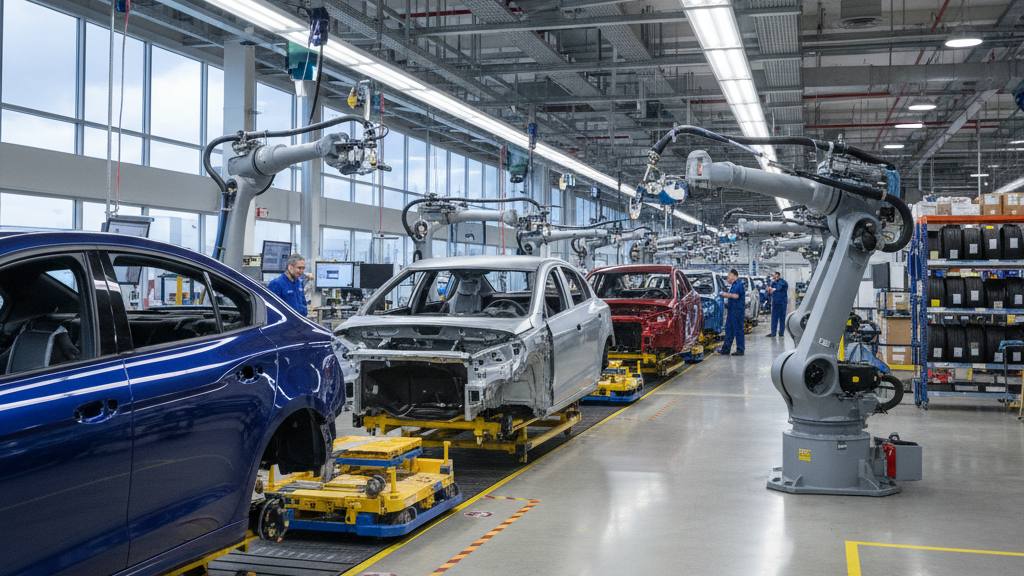
    • The Rise of the Smart Factory: The assembly line is getting a major IQ boost. By integrating AI, IoT sensors, and robotics, manufacturers are creating “smart factories” that are more efficient, flexible, and resilient. AI-powered quality control can spot microscopic defects the human eye might miss, while predictive maintenance on factory equipment prevents costly downtime by fixing machines before they break.
    • Digital Twins: The Virtual Car Before the Real One: Imagine building, testing, and refining a car in a virtual world before a single piece of metal is stamped. That’s the power of “digital twins.” These are detailed virtual replicas of both the product and the production process. They allow engineers to run simulations and identify potential issues early on, drastically reducing development time and costs.
    • Building a Resilient, Agile Supply Chain: Recent global disruptions have shown just how fragile traditional supply chains can be. In response, the industry is using digital tools to create more transparent and intelligent supply chains. AI can now predict potential supplier disruptions, and advanced analytics help optimize inventory levels, ensuring the right parts are in the right place at the right time.

    3. Redefining the Customer Experience: From Dealerships to Digital Journeys

    Perhaps the most profound shift is in how automakers are connecting with their customers. The old model of relying solely on dealerships is being replaced by a more direct, personalized, and continuous relationship.

    • Digital-First Retail: Today’s car buyers often start their journey online. They expect a seamless, omnichannel experience where they can research, configure, and even purchase a vehicle from the comfort of their home. This “digital-first” approach is forcing a reinvention of the traditional dealership, transforming it from a point of sale to a hub for experiences, test drives, and service.
    • Hyper-Personalization at Scale: With data from connected cars and digital interactions, automakers can now understand their customers on an individual level. This allows for hyper-personalized marketing, in-car experiences, and service recommendations. Think of a car that automatically adjusts the seats, climate, and infotainment to your preferences as you approach, or a service alert that’s tailored to your specific driving habits.
    • The Growth of Mobility-as-a-Service (MaaS): For a growing number of consumers, especially in urban areas, the focus is shifting from owning a car to accessing mobility when needed. This has given rise to Mobility-as-a-Service (MaaS) platforms that integrate various forms of transport—ride-sharing, e-scooters, public transit—into a single, on-demand service. Automakers are increasingly positioning themselves as key players in this new mobility ecosystem.

    The Road Ahead

    The digital transformation of the automotive industry is no longer a distant vision of the future; it’s happening right now. The companies that will lead this new era are not just building better cars; they are building smarter products, more efficient factories, and deeper customer relationships. They understand that in this new landscape, the vehicle is just one part of a much larger digital ecosystem. The road ahead is clear: the future of driving is digital, and there’s no turning back.

  • The End of the Waiting Room: Healthcare’s Digital Reinvention Is Here

    The End of the Waiting Room: Healthcare’s Digital Reinvention Is Here

    For generations, the defining image of healthcare has been the waiting room. That sterile, quiet space where we sit, wait, and wonder, armed with a clipboard of repetitive questions. It’s a model built on physical presence, episodic care, and reactive treatment. But a seismic shift is underway, one that’s quietly dismantling that old reality and building something far more dynamic in its place.

    This isn’t just about new gadgets or software; it’s a fundamental rewiring of healthcare’s DNA. We’re witnessing the long-overdue transition from an industry of “sick care” to a proactive, predictive, and deeply personalized ecosystem of “health care.” Technology is the catalyst, but the goal is profoundly human: to make care more accessible, effective, and centered around the one person who matters most—the patient.

    The Clinic is No Longer Just a Building

    The pandemic threw telehealth into the spotlight out of sheer necessity, but what began as a crisis response has matured into a cornerstone of modern medicine. The era of virtual care is here, and it’s far more than just a video call with your doctor. It’s about creating a system of ubiquitous care, where your location is no longer the primary barrier to expertise.

    Think of the old model like a landline phone. It was fixed, reliable, and served its purpose, but you had to be in a specific place to use it. Today’s virtual care platforms are the smartphones of medicine. They untether us, creating an entire ecosystem of possibilities. This includes remote patient monitoring (RPM), where data from connected devices—like smart blood pressure cuffs or glucose monitors—flows directly to care teams, allowing them to intervene before a problem escalates. For patients managing chronic conditions or those living in rural areas, this shift is nothing short of revolutionary. It transforms care from a series of isolated appointments into a continuous, connected conversation.

    AI: Your Doctor’s New Super-Powered Partner

    If there’s one technology acting as the main engine of this transformation, it’s artificial intelligence. AI in healthcare isn’t about replacing doctors; it’s about augmenting them, giving them super-powered tools to see more, know more, and do more.

    Imagine a radiologist analyzing a complex scan. They have years of training and invaluable intuition. Now, give them an AI partner that has been trained on millions of similar images. This AI can flag subtle anomalies the human eye might miss, acting as the ultimate second opinion. Studies have already shown AI systems achieving detection rates for tumors that are comparable to, and sometimes even better than, those of experienced radiologists.

    This partnership extends across the healthcare landscape:

    • Predictive Analytics: AI is becoming healthcare’s early warning system. By analyzing vast datasets from electronic health records (EHRs), wearables, and even genomic information, machine learning models can predict which patients are at high risk for conditions like sepsis, diabetes, or heart disease. This allows providers to move from reactive treatment to proactive, preventive intervention.
    • Personalized Medicine: AI can analyze a person’s unique genetic makeup and lifestyle to help clinicians tailor treatment plans with incredible precision. It’s the end of one-size-fits-all medicine and the dawn of treatments designed for an audience of one.
    • Streamlining Operations: Behind the scenes, AI is optimizing hospital workflows, predicting patient admission spikes, automating tedious administrative tasks, and even accelerating the painfully slow process of drug discovery.

    Your Body as a Real-Time Data Stream

    For decades, your health record was built on sporadic snapshots in time: an annual physical, a blood test, a visit to the ER. It was like trying to understand a river by taking a single photograph of it once a year.

    The Internet of Medical Things (IoMT) and wearable devices have turned that snapshot into a live, flowing stream of data. Smartwatches, continuous glucose monitors, smart inhalers, and even smart implants are providing a constant feed of vital signs and biometric data.

    This real-time information is a game-changer for managing chronic diseases. Instead of relying on a patient’s memory of their symptoms over the past few months, a clinician can see the data—how their heart rate changed during exercise, how their blood sugar fluctuated after a meal—and make far more informed decisions. It empowers patients to become active participants in their own health and provides clinicians with the complete picture they’ve always needed.

    The Patient Is Finally in the Driver’s Seat

    For too long, healthcare has been an industry where the customer experience came last. We’ve become accustomed to seamless, on-demand digital experiences from retail, banking, and entertainment, yet healthcare often remained stuck in a world of phone calls and paper forms.

    That’s finally changing with the rise of the “digital front door.” This concept is about creating a unified, intuitive digital entry point for patients to manage their entire healthcare journey. It encompasses a whole suite of tools:

    • Online appointment scheduling
    • Patient portals with access to lab results and medical records
    • Mobile apps for registration and payments
    • Secure messaging with care teams
    • Telehealth platforms

    By giving patients these tools, healthcare organizations are not just improving convenience; they’re boosting engagement, improving communication, and building loyalty. When patients are empowered with information and control, they become more active partners in their care, leading to better adherence to treatment plans and, ultimately, better outcomes.

    The Unseen Challenge: Fortifying the Digital Fortress

    Of course, this explosion of digital health data creates a massive target for cyber threats. Ransomware and phishing attacks have become distressingly common in the healthcare sector, where the stakes—patient safety and privacy—could not be higher.

    Strengthening cybersecurity is not just a trend; it is a non-negotiable imperative. Healthcare organizations are investing heavily in multi-layered security measures, from advanced encryption to zero-trust architecture, to protect sensitive patient information. As we build this interconnected, data-driven future, building an unshakable foundation of digital trust is paramount.

    The waiting room isn’t going away entirely, but its role as the central hub of healthcare is fading. In its place, we’re building a system that is decentralized, data-rich, and deeply human. This transformation is about more than just technology; it’s about a new promise. It’s the promise of a future where care finds you when and where you need it, where we can predict and prevent illness instead of just reacting to it, and where every patient is empowered to be the CEO of their own health. The reinvention is here, and it’s just getting started.

  • Banking at the Crossroads: Harnessing Near-Term Strength for Long-Term Strategic Advantage

    Banking at the Crossroads: Harnessing Near-Term Strength for Long-Term Strategic Advantage

    Executive Overview:

    The global banking industry finds itself at a significant inflection point, navigating a landscape shaped by potent macroeconomic forces and deep-seated structural shifts. A pivotal development has been the normalization of interest rate policies, which has provided a welcome, albeit potentially transient, uplift to sector profitability, primarily through enhanced Net Interest Income. This improved near-term financial health presents a crucial window of opportunity. Simultaneously, the unrelenting pace of digital transformation, evolving customer expectations, and a dynamic regulatory environment demand sustained strategic focus and investment. Leading institutions, exemplified by Spanish banks such as Santander and BBVA, are strategically maneuvering to capitalize on current tailwinds while rigorously pursuing long-term transformation agendas. Successfully balancing these immediate financial opportunities with the imperatives of future-proofing the business model is the defining challenge for banking leadership in the current era.

    The Reshaped Macro-Financial Environment

    The recent era in banking has been fundamentally reshaped by the decisive move away from prolonged ultra-low interest rates. This policy normalization has had immediate and tangible effects on bank performance. Most notably, the widening spread between asset yields and funding costs, as central banks increased benchmark rates, has fueled significant Net Interest Income expansion. Banks were able to reprice loans upwards relatively swiftly, while the adjustment in deposit rates, although now accelerating, initially lagged, creating a favorable margin dynamic. Institutions possessing large, stable deposit franchises, including prominent players like Santander and BBVA, were particularly well-positioned to benefit from this initial phase.

    However, this improved profitability landscape is not without its complexities and emerging considerations. The same higher interest rates that boost NII inevitably exert pressure on borrowers, necessitating a prudent approach to managing potential increases in credit risk across both retail and corporate loan books. Consequently, banks are proactively adjusting loan loss provisions. Furthermore, the competitive landscape for deposits is intensifying, which is expected to gradually increase funding costs and potentially compress margins from their recent highs. Compounding these factors is the potential for slower economic growth, itself influenced by tighter monetary policy, which could dampen loan demand and moderate income from fees and commissions. Effectively managing this intricate balance between capitalizing on NII opportunities and mitigating evolving risks is therefore a critical focus for bank management.

    The Enduring Imperative of Digital and Technological Advancement

    Flowing beneath these macroeconomic currents is the powerful, ongoing transformation driven by technology, which continues to fundamentally alter banking operating models and competitive dynamics. Recognizing that legacy systems can hinder agility and innovation, leading banks are making substantial investments in modernizing their core banking platforms. Increasingly, this involves migrating critical workloads and data infrastructure to cloud environments, seeking the inherent benefits of scalability, enhanced cost efficiency, accelerated product development cycles, and superior data accessibility.

    Parallel to infrastructure modernization is the diffusion of Artificial Intelligence and advanced analytics across the banking value chain. These technologies are rapidly moving beyond niche applications to become deeply embedded in core functions. Use cases are diverse and impactful, ranging from more sophisticated risk modeling and fraud detection capabilities to the delivery of hyper-personalized customer engagement and product recommendations. AI is also driving significant efficiencies through the intelligent automation of complex processes within middle and back-office operations and enhancing regulatory compliance monitoring. Institutions that successfully integrate and leverage data and AI are poised to achieve significant competitive advantages in both operational efficiency and the quality of their customer value proposition. The engagement model with the fintech ecosystem also continues to mature, moving towards strategic partnerships, API integration through Open Banking frameworks, and the adoption of Banking-as-a-Service models, allowing incumbents to leverage external innovation effectively.

    Strategic Positioning of Industry Leaders

    The strategic responses of major international banks like Santander and BBVA offer valuable insights into how established players are navigating this complex environment. Their significant scale and geographic diversification provide crucial advantages. Operating across diverse economic cycles and interest rate environments, particularly through substantial presence in regions like Latin America alongside their European home markets, enhances earnings resilience and presents varied growth opportunities. This scale also enables them to undertake ambitious investments in technology and develop global platforms, such as Santander’s PagoNxt payments initiative, achieving synergies across their network.

    Furthermore, both institutions have demonstrated a sustained commitment to digital transformation over many years. BBVA is often highlighted for its early adoption of mobile-first strategies, agile working methodologies, and deep integration of data analytics. Santander consistently invests in enhancing its digital channels, automating processes, and developing open banking capabilities across its global footprint. These ongoing investments are essential for improving customer experience and driving operational efficiency. Complementing these digital efforts is an intensified focus on operational excellence. Despite recent revenue tailwinds, rigorous cost management remains a core strategic pillar, with initiatives aimed at optimizing distribution networks, streamlining workflows, and improving cost-to-income ratios. This discipline is vital not only for preserving profitability as funding costs rise but also for generating the capacity needed for continued strategic investment.

    Navigating Evolving Regulatory Landscapes and Societal Expectations

    The operating context for banks is further shaped by an evolving regulatory framework and shifting societal expectations. Regulators maintain a strong focus on ensuring financial stability, reinforcing capital adequacy through measures like the finalization of Basel III/IV, and enhancing operational resilience, with particular attention to cybersecurity and the risks associated with third-party providers, including cloud services. Concurrently, new regulatory regimes are emerging for areas like digital assets.

    Beyond traditional financial regulation, Environmental, Social, and Governance (ESG) factors have moved decisively into the strategic mainstream. Banks face mounting pressure from regulators, investors, employees, and customers to play an active role in financing the transition to a sustainable economy. This involves not only developing green finance products but also integrating climate-related financial risks into their core risk management frameworks and demonstrating strong performance on social and governance metrics. Effectively embedding ESG considerations requires robust data infrastructure, transparent reporting, and the strategic alignment of lending and investment activities – areas where both Santander and BBVA are actively seeking leadership positions.

    Meeting Heightened Customer Expectations

    Ultimately, sustained success in this transformed landscape hinges on meeting the increasingly sophisticated expectations of customers. There is a clear demand for seamless, intuitive, and consistent experiences across all interaction channels – whether digital platforms or physical branches. The optimal approach blends the convenience and efficiency of digital self-service for routine tasks with the availability of expert human advice for more complex financial needs, creating a truly integrated “phygital” model.

    Moreover, customers increasingly expect personalization that goes beyond superficial gestures. Leveraging data analytics and AI to genuinely understand individual circumstances and proactively offer relevant solutions, tailored advice, and timely insights is becoming a powerful differentiator. Underpinning all interactions is the foundational element of trust. In an environment of heightened awareness regarding data privacy and cybersecurity threats, maintaining robust security measures, practicing transparent data stewardship, and upholding ethical standards are absolutely critical for preserving customer loyalty and reinforcing the inherent advantages of established, trusted institutions.

    Strategic Imperatives for the Path Forward

    For banking leaders charting a course through this dynamic environment, several strategic imperatives stand out. It is crucial to capitalize judiciously on the current NII uplift, channeling enhanced profitability towards funding essential strategic priorities like technology modernization, while simultaneously managing the associated credit and funding risks with prudence. The acceleration of digital and core transformation agendas remains paramount, involving continued investment in migrating away from legacy systems, embracing cloud architectures, and deeply embedding data and AI capabilities to drive efficiency and customer value.

    Optimizing operating models through a continued, rigorous focus on cost discipline and process automation is necessary to improve efficiency ratios and support ongoing investment needs. Simultaneously, ESG considerations must be fully integrated into strategic planning, risk management, product development, and reporting frameworks. Elevating customer engagement requires sustained investment in creating seamless, personalized, data-driven omnichannel experiences built upon a bedrock of security and trust. Finally, cultivating future-ready talent – attracting, developing, and retaining individuals skilled in technology, data science, ESG, and agile ways of working – is fundamental to successfully driving the necessary transformation.

    Conclusion:

    The banking sector is currently navigating a period marked by improved near-term financial performance, largely driven by shifts in the macroeconomic environment. However, this favorable phase coincides with deep, ongoing structural changes propelled by technology, regulation, and customer expectations. Leading institutions like Santander and BBVA exemplify the critical need to strategically balance the management of immediate opportunities and risks with the execution of long-term transformation agendas. Those organizations that demonstrate strategic clarity, maintain operational discipline, foster innovation, and adapt with agility to this complex and evolving landscape will be best positioned to achieve sustainable value creation and secure their leadership in the future of banking.

    Carlos Marten